
Projector signs are wall-mounted signs fixed at a right angle to a shopfront, so they’re readable from both directions along the pavement, not just head-on. Because they sit in the line of travel, they reach people before they reach your door. This complete guide explains what projector signs are, how they work, the types and materials, the UK planning rules, how long they last, and what they cost in 2026.
The Sign & Print Factory designs, manufactures, and installs projector signs for UK businesses from a West Midlands workshop, so the explanations below reflect how these signs are actually built and fitted.
What Are Projector Signs?
Projector signs, also known as blade signs, hanging signs, or projecting signs, are mounted perpendicular to a wall on a bracket so the face runs parallel to the pavement. Shoppers read them side-on as they walk towards the premises.
They differ from a fascia, a flat sign fixed flush across the top of the shopfront and visible only straight on. A projector sign does the opposite: it presents your name to people approaching from either side of the street.
The term covers a wide range, from a small painted panel in a decorative wrought bracket to a large double-sided illuminated blade or lightbox. They share perpendicular mounting that keeps them readable along the pavement.
How Projector Signs Work to Catch the Eye
Projector signs work because of geometry. A flat fascia sign offers one viewing angle: you see it only once you are more or less in front of it. A projector sign adds two more angles, one for each approach direction.
That matters because pedestrians decide to slow down or keep walking while they are still several metres away, not when they are already at your window. A sign in their peripheral line of sight reaches them during that decision window.
A sign that projects from the building line also breaks the continuous row of flat fascias, so the eye catches it even on a busy street full of competing signage.
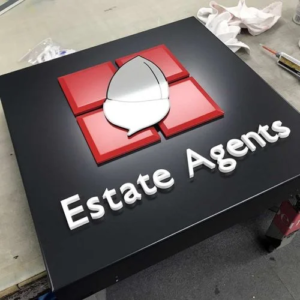
Types of Projector Signs
Projector signs fall into three broad types, separated mainly by whether and how they are lit. The right type depends on your trading hours, your street, and the brand feel you want.
- Non-illuminated panel: a printed or routed board held in a bracket. Best for daytime traders and traditional or heritage high streets where a lit sign would look out of place.
- Illuminated lightbox: a double-sided box with internal LED modules, so the sign reads day and night from both directions. The default choice for evening trade.
- Halo or edge-lit blade: a dimensional sign where light spills softly around or through the edges, giving a premium look suited to boutiques, bars, and hospitality.
Illuminated vs Non-Illuminated Projector Signs
The biggest practical difference is how many hours a day the sign actually works for you. An unlit sign stops communicating at dusk; an illuminated one keeps reading through the evening and in poor daytime light.
| Type | Best for | Works after dark | Typical 2026 cost |
| Non-illuminated panel | Daytime traders, traditional streets | No | £120 to £450 |
| Illuminated LED lightbox | Evening trade, busy roads | Yes | £450 to £1,500 |
| Halo or edge-lit blade | Boutiques, bars, premium brands | Yes | £900 to £2,500 |
Modern LED modules are rated for around 50,000 hours, roughly eight to twelve years of real-world use, and draw very little power. For details on running costs, our guide to what LED signs cost breaks down the figures.
What Projector Signs Are Made From
Knowing the materials helps you judge a quote and understand why prices vary. Most projector signs use a small set of weatherproof components chosen to survive years outdoors.
- Tray and box: usually powder-coated aluminium, which resists rust and holds a crisp edge. Aluminium is light enough to limit load on the wall bracket.
- Faces: acrylic or opal polycarbonate on illuminated signs, so light spreads evenly, or aluminium composite and foamed PVC on flat printed panels.
- Lighting: IP-rated LED modules sealed against moisture, wired to an outdoor-rated transformer.
- Bracket: a galvanised or stainless steel arm bolted into solid masonry, sized to carry a double-sided sign in wind.
The weak point in a cheap sign is rarely the artwork; it is non-rated LEDs or a bracket undersized for wind load, which separates a sign that lasts a decade from one that fails in two winters.
Where Projector Signs Work Best
Projector signs are one of the highest-value shopfront signage ideas for premises where a fascia alone struggles to be seen. A few situations suit them especially well.
Narrow high-street units have little fascia width, so the projecting sign claims the pavement sightline instead. Corner sites gain two full approach angles, turning the sign into a wayfinder for people coming from either road.
First-floor and upper-floor tenants with no ground-floor fascia often have no street presence. A projector sign at the right height puts the business name back at eye level where passers-by will see it.
How to Design a Projector Sign That Reads Clearly
Because a projector sign is read side-on and at a glance, legibility has to come before decoration. The design works in a fraction of the time a customer spends studying a fascia.
- High contrast: a dark background with light lettering, or the reverse, reads much further down the street than tonal or pastel designs.
- One or two brand colours: keep the palette tight so the sign registers instantly rather than competing with itself.
- A simple mark: a logo, one short name, or a single icon beats a panel crammed with detail.
- Double-sided artwork: each direction of travel sees a different face, so make sure both carry the brand clearly.
The rule of thumb is that the projector signs that say the least get read the most, because the eye takes them in in a single glance.
Planning Rules for Projector Signs in the UK
Check the rules before you commit to artwork, because displaying a sign without the right consent is a criminal offence. Projector signs face slightly more regulation than flat fascias because they overhang the pavement.
Some small, non-illuminated projector signs benefit from deemed consent and need no application, as long as they stay within strict size, height, and projection limits set by the UK Planning Portal. Beyond those limits, you usually need advertisement consent from your local council.
You will typically need advertisement consent for an illuminated projector sign, any sign above 4.6 metres from the ground, or any sign on a listed building or in a conservation area. Signs projecting over a public highway attract extra scrutiny, so confirm footway clearance with your council first.
Application fees are modest, around £132 at councils such as Sandwell and Dudley, but decisions can take six to eight weeks. If you are weighing up what goes outside versus inside, our guide to internal vs external signs explains the differences.
How Long Projector Signs Last and How to Maintain Them
Well-made external projector signs last seven to ten years, and the LED modules inside an illuminated blade are rated for roughly 50,000 hours, about eight to twelve years of normal use. Printed faces may fade a little sooner than the structure.
Maintenance is light. Wipe down the faces two or three times a year to keep them bright and prevent grime from dulling the light output, and do a quick annual check of the bracket fixings to catch any movement before it becomes a problem.
When an older sign looks tired, the tray and bracket are often still sound, so swapping worn LED modules or reprinting a faded face usually costs far less than a full replacement.
What Projector Signs Cost in the UK in 2026
Prices depend on size, materials, and whether the sign is lit. These are realistic 2026 UK ranges to help you budget before you request a quote.
- Non-illuminated bracket or hanging sign: £120 to £450
- Illuminated LED lightbox projector sign: £450 to £1,500
- Halo or edge-lit premium blade sign: £900 to £2,500
- Decorative wrought bracket only: £60 to £250
Since a well-made sign lasts the best part of a decade, it is worth seeing the figure as a multi-year cost. A projector sign is also usually cheaper than a full fascia replacement.
Choosing a Supplier: How The Sign & Print Factory Helps
Once you understand the type and budget that fit, the remaining question is who builds it. Projector signs are part of our full range of signs so that we can match your blade sign to your fascia and interior from one workshop.
- Free site survey: we measure your frontage, check wall fixings and pavement clearance, and flag any planning issues before you commit.
- Design and artwork: we mock up your projector sign with revisions and a colour proof, so you approve both faces before manufacture.
- In-house manufacture: we build the sign using weatherproof materials and IP-rated LED modules.
- Installation and aftercare: insured fitters mount the bracket, remove old signage, connect the supply, and back every install with a 12-month workmanship warranty.
Ready to Plan Your Projector Sign?
If you trade on a narrow unit, a corner, or an upper floor, or you simply disappear after dark, a projector sign is one of the most effective frontage upgrades available. The best next step is a firm, itemised quote based on your actual premises.
Request a free projector signs quote, usually returned within 24 hours, or call 01384 912060 for a same-day rough figure. You can also contact the team to book a free site survey.
We design, manufacture, and install projector signs for business customers across the West Midlands, including Tipton, Birmingham, Dudley, Walsall, Wolverhampton, West Bromwich, Oldbury, Wednesbury, Rowley Regis, and Blackheath.
Frequently Asked Questions
What are projector signs?
Projector signs are mounted at a right angle to a wall on a bracket, so they read from both directions along the pavement. Also called blade or hanging signs, they catch pedestrians before they reach your door.
Do I need planning permission for projector signs in the UK?
Often, yes. Illuminated projector signs, anything above 4.6 metres, signs over a highway, or signage on listed buildings and in conservation areas usually need advertisement consent. Small non-illuminated signs may have deemed consent. Always check first.
How much do projector signs cost in the UK in 2026?
A non-illuminated bracket sign runs £120 to £450, an illuminated LED lightbox £450 to £1,500, and a premium halo or edge-lit blade £900 to £2,500. A decorative bracket alone starts near £60.
Should projector signs be illuminated?
If you trade into the evening or sit on a busy road, yes. Illumination roughly doubles the hours the sign works for you. LED lightbox blades give the best value; halo-lit versions cost more for a premium glow.
Where do projector signs work best?
They suit narrow units, corner sites, and upper-floor tenants with no ground-floor fascia. Any shopfront hard to see head-on benefits, because the sign claims the pavement sightline from both directions.
How long do projector signs last?
Well-made projector signs last seven to ten years, and their LED modules last around 50,000 hours, roughly eight to twelve years of use. Installation quality matters as much as materials.